

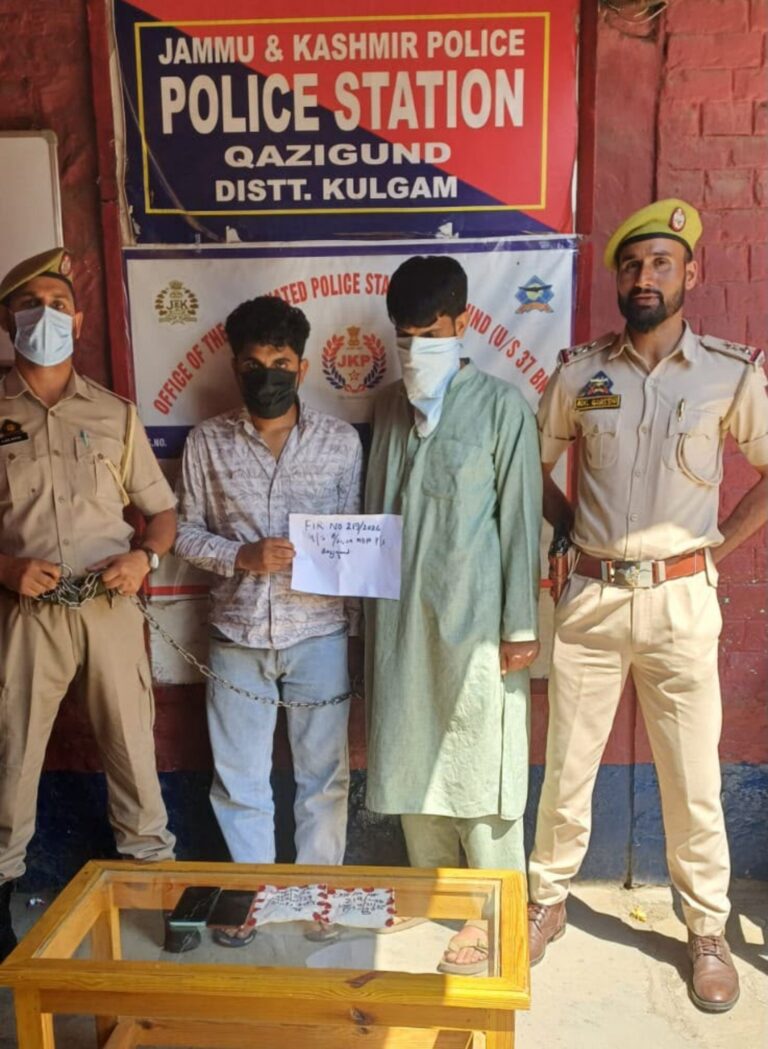
Kulgam police arrested 02 drug peddlers Riaz Gafar Mir & Hanan Mushtaq R/O Khanmoh, Srinagar & recovered 17 gram of Heroin-like contraband. Case 219/2026 U/S 8/21,29 NDPS act registered at PS Qazigund & investigation takenup.
J&K Health Department Terminates Probation, Discharges MTS Employee

The Jammu and Kashmir Health and Medical Education Department has terminated the probation of MTS employee Mir Omar Bin Farooq and discharged him from service over prolonged unauthorized absence.
He was appointed in 2022 and joined his duties the same year. Later, he applied for study leave for 30 months but remained absent without waiting for approval of his request. The department issued several show-cause notices to him and, in a final notice issued in May 2026, warned him of action.
However, his request was found not in accordance with the applicable rules. The department has now terminated his probation and discharged him from service with effect from January 2, 2026.
DC Budgam launches 15-Day Swachhata Hi Seva 2026 campaignAdministers Swachhata Pledge, Initiates signature campaign for cleanliness across District
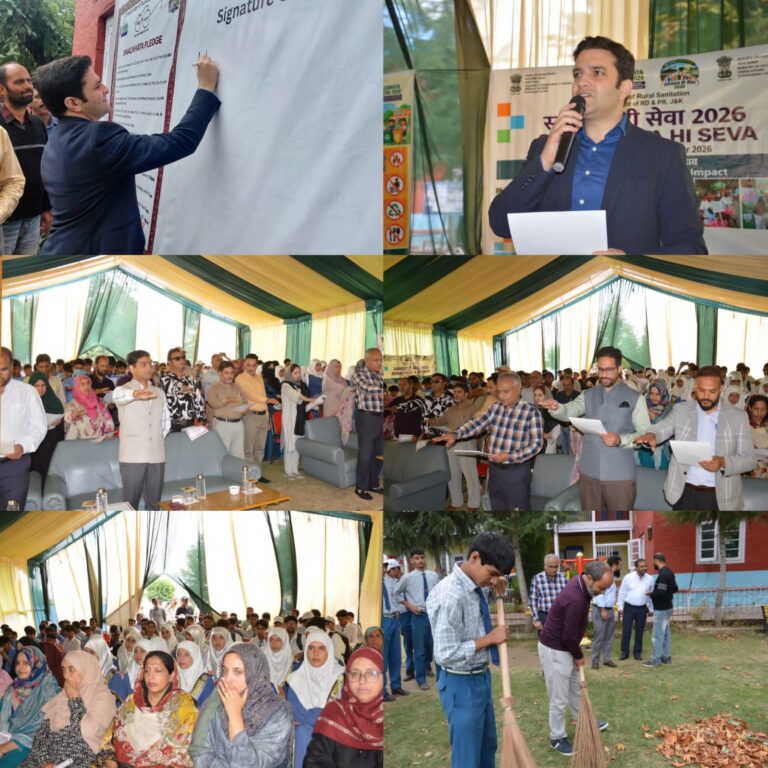
DC Budgam launches 15-Day Swachhata Hi Seva 2026 campaign
Administers Swachhata Pledge, Initiates signature campaign for cleanliness across District
BUDGAM, SEPTEMBER 17: Deputy Commissioner Budgam, Athar Aamir Khan, today launched the 15-day Swachhata Hi Seva 2026 campaign at Boys Higher Secondary School, Budgam.
At the outset, the Deputy Commissioner administered the Swachhata pledge to the participants and initiated a signature campaign to promote cleanliness and sanitation across rural and urban areas of the district.
Addressing the gathering, the Deputy Commissioner said that cleanliness cannot be achieved through a one-time effort and requires continuous participation from everyone. He called upon people to come together and make collective efforts to keep their surroundings, towns, villages, and the district clean.
The DDC said that every individual, family and community has an important role to play in maintaining cleanliness and ensuring a cleaner environment.
Students and other resource persons also addressed the gathering and pledged to contribute towards maintaining cleanliness in their surroundings.
Among others, ADDC Budgam, Vivek Agarwal, ACP Budgam, Principal Boys Higher Secondary School, BDO and other concerned officers and officials attended the programme.
Ladakh Lieutenant Governor Vinai Kumar Saxena directs settlement of rights, claims of local community in protected areas, within two months
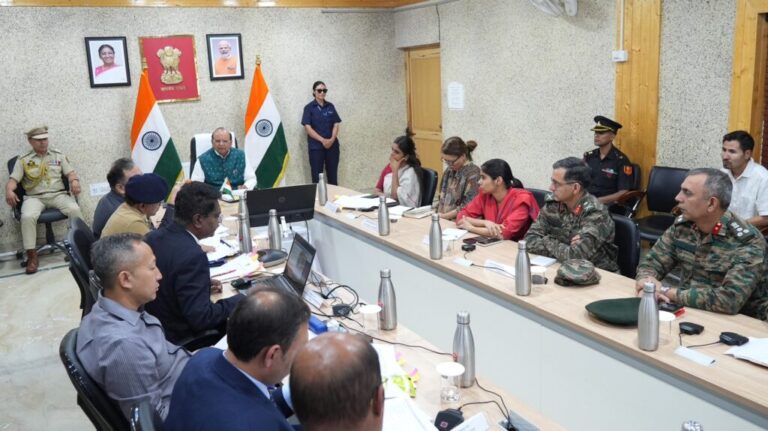
Ladakh Lieutenant Governor Vinai Kumar Saxena has ordered the complete settlement of rights and claims for local communities across three major protected zones, within two months, which include Hemis National Park, Changthang Wildlife Sanctuary, and Karakoram Wildlife Sanctuary.
One of the key agenda items of the Board meeting was the consideration of the sub-committee report on finalisation of the boundaries of these three protected wildlife areas.
According to a press release, in a development that will have far-reaching implications and offer relief to the local communities, Lieutenant Governor Vinai Kumar Saxena has directed the completion of the settlement of rights and claims of local communities in three protected areas of Ladakh Hemis National Park, High Altitude Cold Desert (Changthang) Wildlife Sanctuary and Karakoram (Nubra–Shyok) Wildlife Sanctuary within two months.
This will pave the way for a lawful and participatory process for finalising their boundaries, particularly in the newly created districts.
The direction was issued on Friday during the 16th Meeting of the newly constituted State Board for Wildlife (SBWL), UT Ladakh, chaired by the Lieutenant Governor. The decision is expected to bring long-awaited clarity and certainty to local communities, who have been seeking clarity regarding the boundaries of the protected areas and recognition of their longstanding settlements, habitations and traditional rights.
It has been the demand of the local people that settlements and human habitations have existed for a very long time in these areas, which clearly fall outside the purview of the wildlife sanctuary. However, the earlier formed sub-committee included all these areas, the release said.
The erstwhile Jammu and Kashmir government had issued a preliminary notification of the boundaries of these sanctuaries in 1987. However, the Board, while deliberating threadbare on the final notification of the three protected areas, noted that the notification issued by the erstwhile Government of Jammu and Kashmir had not correctly mapped the boundaries of the protected areas on the ground.
LG Saxena, during the Board meeting, observed that the statutory process prescribed under the Wildlife (Protection) Act, 1972, for settlement of rights of individuals and communities residing in the proposed protected areas, has not been undertaken by the Committee. He noted that this process was not initiated and that the delineation of boundaries was carried out through a table-top exercise, without adherence to the legal framework. This rendered the exercise inconsistent with the provisions of the Act, inequitable to affected communities, and susceptible to legal challenges.
The Board observed that several of the areas included in the sub-committee report are of strategic importance and relate to national security, and the mandatory defence considerations were not duly factored into the report of the sub-committee.
Saxena also observed that the international boundaries, as depicted in the Survey of India maps, have not been taken as a reference point, which is essential while determining the limits of any protected area.
Accordingly, taking serious note of the discrepancies, LG Saxena directed that the report of the sub-committee be submitted.
The Board also directed the designated DCs /Settlement Officers to resume the process of public hearings and to complete the proceedings within a period of two months.
Saxena urged the people to come forth with their claims and titles of land and traditional rights, including those on pasture lands, to enable the administration to arrive at a fair decision on the boundaries of these protected areas. The Board noted that an early completion of the settlement process would be of great significance to local communities, as it would bring greater clarity, certainty and recognition to their bona fide rights in these protected areas.
At the same time, it would also provide a clearer framework for wildlife conservation and development activities within these landscapes.
The Board, in its meeting, also ratified 23 important projects and sent them to the Standing Committee of the National Board of Wildlife, Government of India, for clearance. These included proposals relating to power transmission infrastructure in strategically important border areas, defence infrastructure and other essential projects in the Karakoram and Changthang regions.
DC Poonch Ashok Kumar Sharma felicitated NEET & academic achievers at Shia Federation’s ceremony in Town Hall, Poonch. He called upon students to pursue goals with hard work and dedication
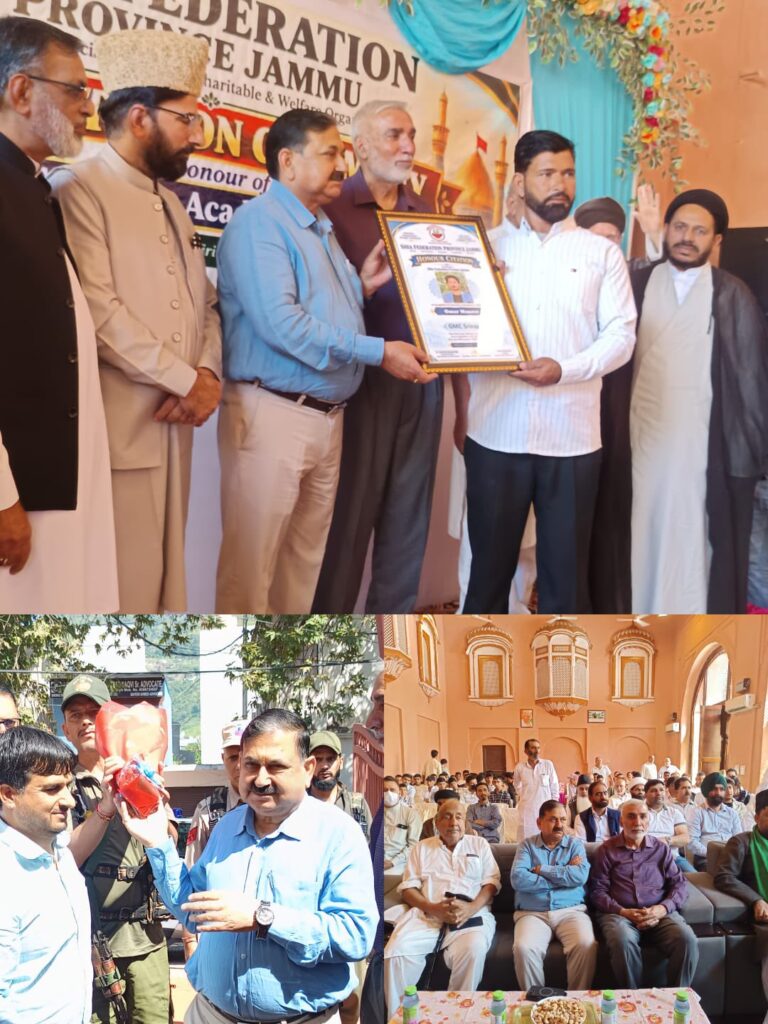
DC Poonch Ashok Kumar Sharma felicitated NEET & academic achievers at Shia Federation’s ceremony in Town Hall, Poonch. He called upon students to pursue goals with hard work and dedication.
Rana inaugurates ₹6.53 cr water project in Channi Himmat, Bahu; lays foundation for ₹5.90 cr scheme for Bathindi, Sunjwan
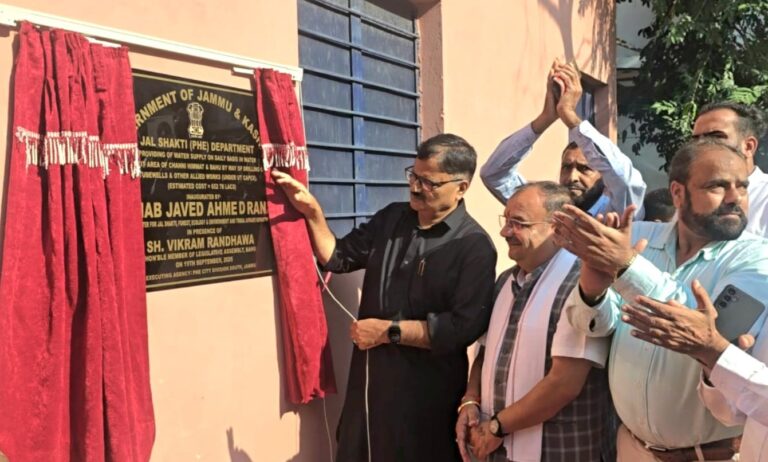
Rana inaugurates ₹6.53 cr water project in Channi Himmat, Bahu; lays foundation for ₹5.90 cr scheme for Bathindi, Sunjwan
Minister for Jal Shakti, Forest, Ecology & Environment and Tribal Affairs, Javed Ahmed Rana, today inaugurated a water supply project for the areas of Channi Himmat and Bahu and laid the foundation stone of a water supply augmentation project for Bathindi and Sunjwan, with the two projects having a combined estimated cost of ₹12.43 crore.MLA Bahu Vikram Randhawa, along with senior officers of the Jal Shakti Department and other concerned departments, were present on the occasion.The Minister inaugurated the water supply project for Channi Himmat and Bahu, executed at an estimated cost of ₹652.78 lakh. The project is aimed at ensuring regular and daily water supply to residents of the areas that have been facing shortages.The project included the drilling of new tubewells and allied works to augment the availability of drinking water and strengthen the existing supply arrangements.Addressing the gathering, the Minister said the completion of the project marks an important step towards resolving the water deficit in the affected areas and providing households with a more reliable supply of drinking water.He said that ensuring access to safe, adequate and dependable drinking water remains a key priority of the government, adding that the newly commissioned infrastructure would provide much-needed relief to residents and improve the overall water supply position in the area.Later, the Minister laid the foundation stone of the water supply improvement and augmentation project for Bathindi and Sunjwan, under SASCI, at an estimated cost of ₹590.50 lakh.The project is aimed at strengthening the existing water supply infrastructure and augmenting its capacity to meet the present and emerging requirements of the rapidly developing areas.Once completed, the scheme is expected to improve water availability and enhance the reliability of supply for residents of Bathindi and Sunjwan.The Minister directed the concerned officers to ensure that the Bathindi and Sunjwan augmentation project is completed within the stipulated timeline, while maintaining the prescribed standards of quality.He also stressed the need for proper operation and maintenance of the newly commissioned tubewells to ensure that the benefits of the completed project reach residents without interruption.The two projects form part of a broader series of inaugurations and foundation stone-laying ceremonies undertaken during the past week to strengthen and expand water supply infrastructure across Jammu.MLA Bahu Vikram Randhawa expressed gratitude to the Minister for taking up the projects and said the initiatives would provide significant relief to residents who had been facing difficulties due to inadequate water supply.Later, the Minister chaired a meeting with senior officers of the Jal Shakti Department to take stock of the water supply situation in the area and review the progress of ongoing and proposed works.During the meeting, the Minister directed the officers to prepare Detailed Project Reports (DPRs) for all pending and proposed water supply schemes without delay, so that the projects could be processed for approval and funding at the earliest.Emphasising the importance of long-term planning, he asked the department to take into account population growth, future water demand and the changing requirements of urbanising areas while designing new and upgraded water supply schemes.The Minister also called for close coordination among field units and directed officers to ensure prompt and effective redressal of public grievances related to water supply.
Continuing its war against the drug menace, Anantnag Police arrested one more drug peddler near Bypass Library and recovered 4.30 gms charas. FIR No. 306/2026 u/s 8/20 NDPS Act registered at PS Anantnag
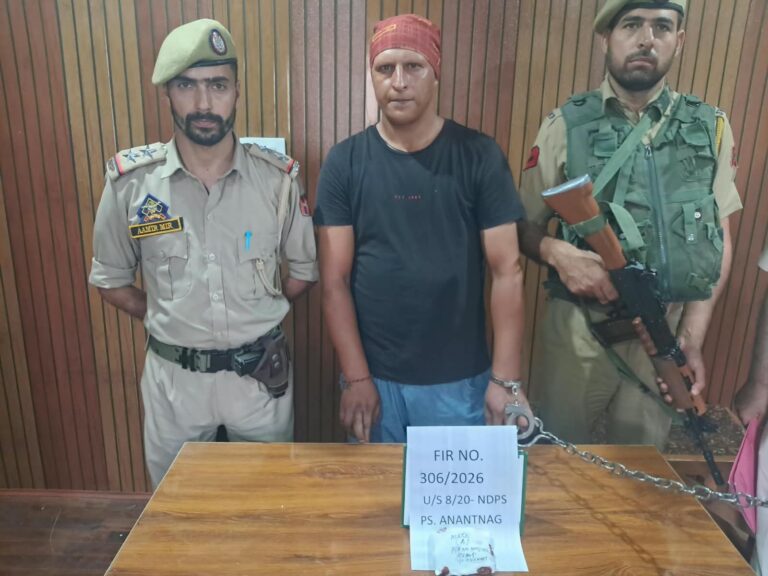
Continuing its war against the drug menace, Anantnag Police arrested one more drug peddler near Bypass Library and recovered 4.30 gms charas. FIR No. 306/2026 u/s 8/20 NDPS Act registered at PS Anantnag
HANDWARA POLICE SEIZED EIGHT MOTOR BIKES AND ONE VEHICLE FOR VIOLATION OF TRAFFIC RULES BESIDES TWO TRACTOR CARRYING ILLIGAL MINED MATERIAL HAVE BEEN SEIZED
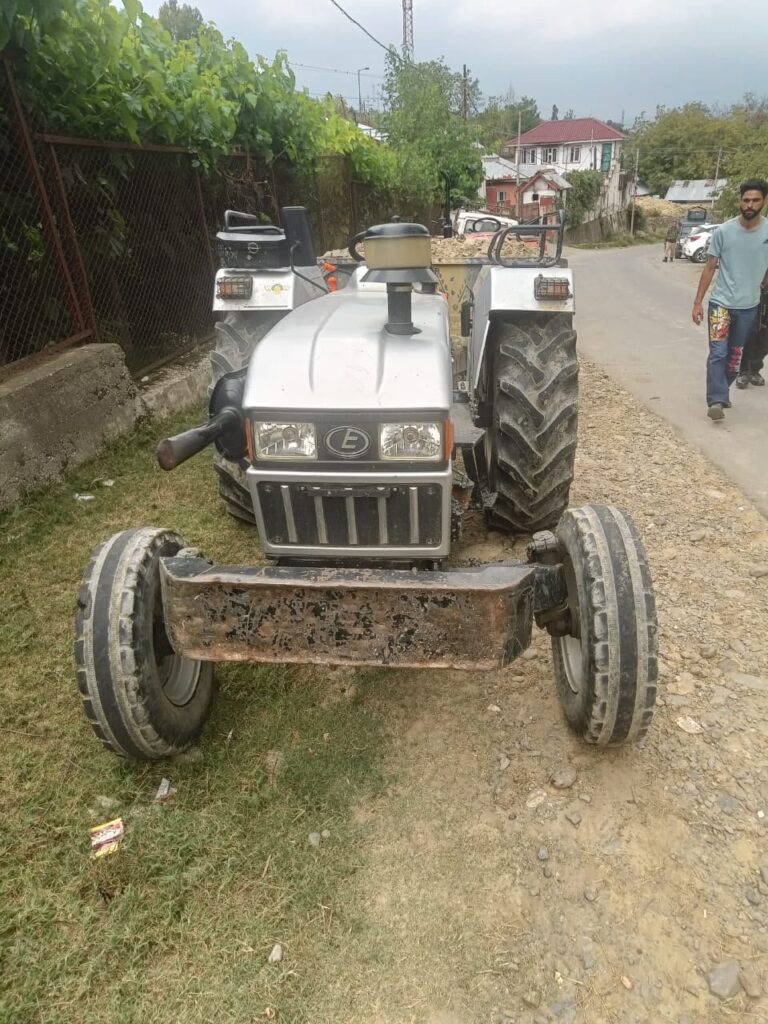
HANDWARA POLICE SEIZED EIGHT MOTOR BIKES AND ONE VEHICLE FOR VIOLATION OF TRAFFIC RULES BESIDES TWO TRACTOR CARRYING ILLIGAL MINED MATERIAL HAVE BEEN SEIZED
Baramulla Police seized 11 commercial vehicles at Mirgund during naka checking for plying without valid documents. Action taken under Sec. 207 MV Act. Strict enforcement against traffic violations will continue to ensure road safety and compliance
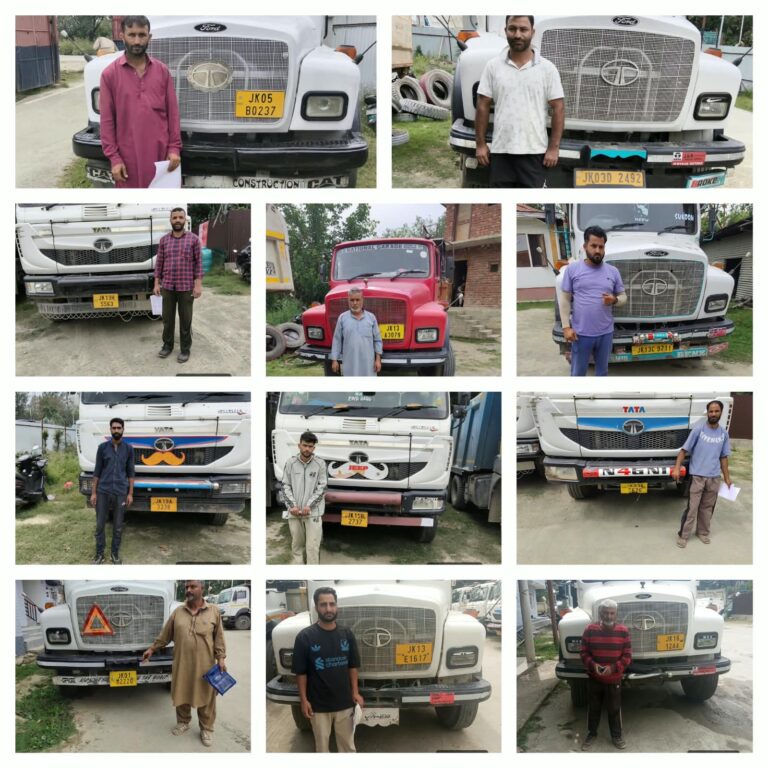
Baramulla Police seized 11 commercial vehicles at Mirgund during naka checking for plying without valid documents. Action taken under Sec. 207 MV Act. Strict enforcement against traffic violations will continue to ensure road safety and compliance.
CJI Surya Kant Calls For Shift From Retrospective To Preventive Justice In Infra Projects
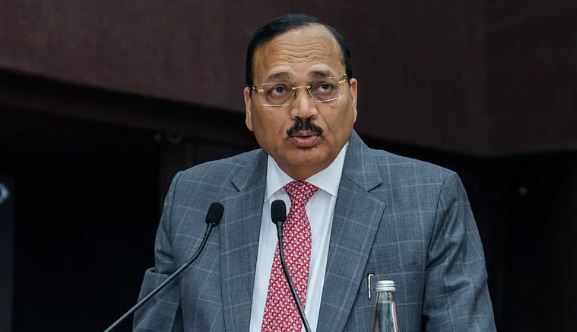
Observing that “infrastructure is inherently exposed to the unexpected”, Chief Justice of India Surya Kant on Monday called for a fundamental shift from retrospective justice to preventive justice in infrastructure development, saying the rule of law is not just about correcting the wrong but also about creating conditions where things go right.
Addressing the FIDIC Global Infrastructure Conference here, the CJI also said that the real measure of success is not simply how quickly disputes are resolved, but how well the projects are designed so that fewer disputes arise in the first place.
“Rule of law is not only about correcting what has gone wrong; it is also about creating the conditions for things to go right,” he said.
“What our infrastructure ecosystem therefore needs is a shift from retrospective justice to preventive justice: from questioning, after the project has been disrupted, to designing the contractual and institutional framework so that disagreements can be identified and addressed before they become disputes through communication and dispute avoidance mechanisms.
“After all, the finest compliment to a dispute resolution mechanism is not that it has resolved many disputes, but that the project it served had so little need to use it,” the CJI said.
Observing that as the chief justice, he has “profound faith in the courts”, Justice Kant, however, said, “But I have no hesitation in saying that a legal system should not measure its success only by how effectively it resolves disputes after they have arisen; it should also ask how effectively the institutions around a project prevent those disputes from arising in the first place.”
A bridge cannot pause construction while an arbitration proceeds, or a highway cannot wait for an appeal to run its course, he added.
The CJI said infrastructure development directly affects the lives of millions, with roads, bridges, water systems and other public assets shaping the everyday experiences of citizens.
Justice Kant noted that well-drafted contracts should do more than record commercial arrangements and they should establish a shared understanding of how parties would respond to unforeseen circumstances, including changes in ground conditions, regulatory developments and other risks.
The CJI said the allocation of risk is among the most important factors determining whether an infrastructure project has become a landmark or a liability.
He cautioned that when risks are assigned to parties ill-equipped to manage them, contractors tend to price defensively, while governments could end up bearing risks which they are not best placed to handle and such imbalances often result in disputes and litigation.
The CJI also stressed the importance of standardisation in infrastructure contracts, particularly as projects increasingly involve international capital, engineering expertise, construction companies and consultants from different jurisdictions.
He said standardisation could provide a common contractual vocabulary for dealing with issues such as payments, variations, extensions of time, unforeseen conditions and dispute resolution.
He urged the stakeholders from the government, industry and the legal profession to focus on five priorities: “clarity of obligations, balanced allocation of risk, sensible standardisation, early dispute avoidance, and swift and independent resolution of disputes”.
“These are not narrow legal technicalities confined to the small print of a contract. They are, in the fullest sense, instruments of good governance,” the CJI said. (Agencies)