


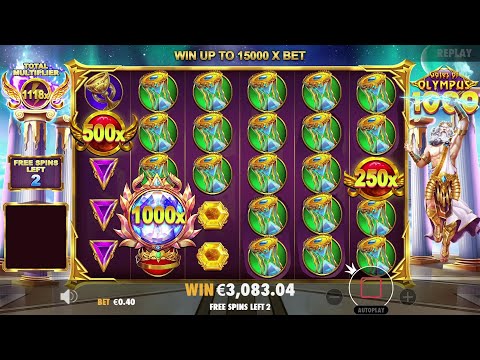
Free spin bonus rounds represent the key attraction in many modern slots https://gatesofolympus1000demo.eu. They turn a routine spin session into something significantly more thrilling—the spot where a game’s real payout potential hides. Take Gates of Olympus 1000. Its free spins feature goes beyond a simple re-trigger trick. It’s a careful design choice that redefines volatility, multiplier buildup, and the maximum win ceiling. Knowing how these rounds operate, what activates them, and how they differ from regular spins helps players evaluate risk, reward, and the pace of the game. This article analyzes free spin bonus rounds, using Gates of Olympus 1000 as the chief example while also looking at wider slot mechanics to show why these features grab so much attention from players and developers alike.
What Free Spin Bonus Rounds Really Represent and Why They Matter
A free spin bonus round represents a separate phase during which you receive a set number of spins without touching your balance. In most slots, these spins come with boosted conditions—extra wilds, locked multipliers, bigger reels, or cumulative win boosters—that tilt the math toward higher average returns during the feature. The appeal is simple: you get more chances to hit winning combos without paying per spin, and the rules are improved in ways that rarely or never happen in the base game. That mix of zero risk and souped-up mechanics is why free spins are the moment every player waits for. It’s not just about the free plays—it’s about securing a crack at the game’s best possible outcomes.
In Gates of Olympus 1000, the free spins round incorporates a persistent global multiplier to the scatter-pays engine. During base play, multiplier symbols show up with values from 2x to 500x and are applied right away to any win in that tumble sequence. Once free spins start, every multiplier symbol that lands gets added to a running total that never resets between spins. That one change flips the whole payout structure. Even a small cluster of symbols can transform into a huge win when multiplied by a total that’s been growing over several spins. The round isn’t just important because it’s free—it’s where the slot’s maximum math ceiling really becomes reachable.
Beyond any single game, free spin rounds serve a structural role in slot math. Developers employ them to deliver controlled bursts of high volatility without id.tradingview.com making the base game too barren. By concentrating a big chunk of the game’s theoretical return into a feature that hits only occasionally, designers can preserve the base game’s hit frequency low while still providing a competitive overall RTP. For players, grasping this split is key. It reveals why long runs of tiny or no wins often come before a bonus, and why the feature feels so much more rewarding when it finally arrives. That uneven distribution is by design, not a glitch.
The method Free Spins Are Triggered in Gates of Olympus 1000
Entering the free spins in Gates of Olympus 1000 depends on a scatter system that’s straightforward. The game features a 6-reel, 5-row grid with no traditional paylines. You need eight or more matching symbols anywhere on the screen to form a win. The trigger is the Zeus scatter symbol, which appears on all reels with a golden laurel design. Get four or more scatters at the same time during a base game spin, and the free spins feature kicks in straight away, providing 15 free spins no matter how many extra scatters you got beyond the four. It’s a clean, no-nonsense trigger condition.
The trigger is established at four scatters on purpose. It achieves a balance between being attainable and staying uncommon. Three scatters award a cash prize—3x, 5x, or 100x your bet depending on how many—but they won’t start the bonus. So players often find themselves painfully close without quite getting there, a design trick that creates tension and maintains the base game feeling dynamic. The odds of landing four or more scatters naturally are small, which matches the slot’s high volatility. But when that fourth scatter lands, you won’t miss it: the screen goes dark, Zeus raises his hand, and the free spins counter shows up.
You can also acquire your way into the feature where the option is available. Players can buy instant entry to the free spins round for 100 times the current total bet. This bypasses the base game trigger entirely and drops you straight into the 15 free spins with the same rules and multiplier buildup. The buy feature is unavailable in every jurisdiction, but where it is, it offers a way to jump straight into the bonus dynamics without waiting for natural scatters. The cost is set so the long-term expected value stays in line with the game’s RTP—the house edge stays whether you trigger the feature or buy it.
- Four or more Zeus scatter symbols on a single base game spin start the bonus.
- Three scatters pay a cash prize but do not activate free spins.
- The feature awards exactly 15 free spins upon activation.
- Additional scatters during the feature give 5 extra free spins each.
- A bonus buy option (100x bet) instantly launches the round where permitted.
Comparing Standard Spins and Free Spins: RTP and Volatility Dynamics

Gates of Olympus 1000 generally has a theoretical payout (RTP) of 96.50% in its standard configuration, though operators can present smaller percentages. That RTP is a long-term average combining the primary game and the free spin feature. The payout isn’t spread evenly across the two stages. The primary game runs at a reduced effective RTP, frequently returning about 60% to 70% of bets over extended sessions, while the bonus round contributes a far greater share of that 96.50%. This structure is common for high-volatility slots and explains why games that miss the bonus often end in a total loss. The main game is built to be a struggle; the bonus is where the serious money moves.

Variance—or dispersion—explains how returns are distributed over time. Gates of Olympus 1000 is very volatile, so wins are infrequent but can be big. The bonus round cranks this up because the increasing multiplier generates huge swings in outcomes. In the base game, the max single-spin win is limited without a persistent multiplier, so even a display loaded with premium symbols provides a limited outcome. In free spins, that similar display can be priced at a multiple thanks to the built-up multiplier, generating the type of payout surges that define high-volatility slots what they are.
For users, the main lesson is that the bonus round isn’t just a feature—it’s the primary method the game provides its advertised win potential. Fund management often reduces to outlasting the primary game sufficiently long to reach the round. The contrast between the two phases also influences how the game performs: the primary game can feel punishing and monotonous, while free rounds pack concentrated excitement and the opportunity for a game-altering outcome. Acknowledging this discrepancy helps set practical expectations and illustrates why the bonus round is the main focus of any slot review. If you’re not triggering bonus rounds, you’re likely falling behind.
A Multiplier System That Shapes the Free Spin Experience
Multiplier symbols drive Gates of Olympus 1000, and they function in a different way in the base game versus free spins. In each stage, multiplier orbs resemble coloured spheres with wings, holding random values: 2x, 3x, 4x, 5x, 6x, 8x, 10x, 12x, 15x, 20x, 25x, 50x, 100x, 250x, or 500x. In the base game, when a multiplier symbol lands during a winning tumble, its value joins to that sequence’s total win and then disappears. In the free spins round, every multiplier symbol that lands is added to a running total that remains for the whole feature. That difference is everything.
This persistent accumulation is what sets Gates of Olympus 1000 apart from slots where multipliers work for one spin. Once free spins start, a meter indicates the running total multiplier, which begins at 1x and grows with every multiplier symbol that lands—even if that spin yields no win. When a tumble sequence pays, the current total multiplier is applied to that win, and the multiplier stays put for the next spins. The effect is a snowball effect: later free spins have a lot more power because the multiplier has had time to build up, turning even small symbol clusters into serious payouts.
The Accumulating Multiplier in Practice
Envision a free spin where the total multiplier has risen to 50x after a few multiplier symbols have appeared. A small win of 5x your bet from a cluster of low-value gems suddenly pays 250x. If another multiplier symbol worth 100x lands during that same tumble, the total multiplier leaps to 150x, and any later win in that spin sequence gets boosted by that new number. Because tumbling reels remove winning symbols and let new ones fall, a single free spin can cause multiple win evaluations, each one benefiting from the growing multiplier. This interplay between tumbling wins and a multiplier that never resets is what generates the slot’s trademark high-volatility spikes.
There’s no upper bound on the total multiplier during free spins, and that’s a big deal. Individual multiplier symbols top out at 500x, but the accumulated total can theoretically extend into the thousands if enough multiplier orbs land across the 15 free spins and any retriggers. This open-ended design is what enables the 15,000x max win possible. It also means outcomes are scattered all over the place. Many free spin rounds conclude with a modest total multiplier and a modest return, while a tiny fraction hit crazy levels, offering the kind of wins that earn the game its reputation and make players coming back.
The purpose of Scatter icons inside the Bonus Spin Feature
Scatter signs don’t disappear once free spins begin. They keep working, triggering again extra spins. During the feature, whenever 3 or more Zeus scatter symbols hit the reels, you obtain 5 extra bonus spins given to your remaining spins. This can happen multiple times, and there is no maximum on the amount of additional spins you can get—though the 15,000x top payout ceiling imposes a practical limit on things. Being able to extend the bonus is very beneficial as it offers more chances for multiplier orbs to appear and increase the total multiplier. Each additional spin is one more opportunity at a massive payout.
The retrigger requirement within free spins is somewhat easier than the standard game requirement. You need four scatter symbols to begin the bonus, but just three within the bonus to award 5 spins. That easier condition makes extra triggers more frequent when the bonus is live—a carefully chosen mathematical decision. It stretches the average length of the feature and creates momentum, as you observe simultaneously the free spin counter and the overall multiplier increase at the same moment. Each retrigger also revives the anticipation, as every fresh group of spins provides the possibility for more multiplier symbols and further retriggers.
During free spins, the scatter icon does not award directly—its only job is to grant spins. That prevents the game from experiencing the common trap of scatter payouts reducing the multiplier influence. During the feature, every symbol on the grid is or a paying symbol that can create clusters or a multiplier symbol that adds to the accumulated multiplier. Scatter icons simply act as a controller to additional playtime. This simple separation ensures the bonus concentrated and prevents unnecessary complexity, enabling you to track just two things: the free spin count and the multiplier display. This is a clean, elegant approach.
Approaches for Optimizing Benefits In Free Spin Bonus Rounds
No strategy can change the RNG or the predetermined math of the game, but you can always make choices that enhance your gameplay and actions during free spin rounds. The main thing to consider is bet sizing compared with your bankroll. Since you can purchase the free spins feature for 100x your bet, players who plan to use the buy option should figure out how many buy-ins their balance can manage. A typical rule of thumb is to have at least 300 to 500 times the buy-in cost to ride out the feature’s natural variance—it often returns less than the purchase price. That cushion helps you prevent draining your bankroll on a cold streak of bought bonuses.
When free spins activate naturally, you are unable to control the bet size for that round—it’s set at whatever stake was in use when the scatters hit. That means steady bet sizing crucial. If you hop around with your bet amount, you risk triggering the feature on a minimum stake after playing higher, which can result in a letdown. Maintaining a flat bet or a tight range guarantees your free spins, when they come, match the risk level and potential reward you were targeting. Consistency pays off in the long run.
During the free spins themselves, there’s not much to do but view the tumbles and multiplier grow. The game instantly applies the total multiplier to any win, and retriggers happen instantly. With no decisions to take, any strategy has to happen before the round starts. Also, keep in mind the max win cap of 15,000x your bet. If a spin or tumble sequence reaches that limit, the round stops right there, and any remaining free spins are forfeited. Hitting the cap is uncommon, but being aware of this rule avoids confusion if the feature unexpectedly stops after a monster win. It’s a nice problem to have, but it’s nonetheless worth knowing.
Widespread Misconceptions About Free Spin Bonus Rounds
A widespread myth among slot players is that free spin rounds are ‘due’ after a long dry spell in the base game. This comes from the gambler’s fallacy—the mistaken idea that past outcomes affect future independent events. In Gates of Olympus 1000, the RNG determines each spin’s outcome on its own, and the chance of landing four scatters is the same on every spin. Going 500 spins without a bonus doesn’t make a trigger any more likely on spin 501. The game’s volatility can create long gaps, but that’s just a natural result of the hit frequency, not a sign that a payout is coming. The machine has no memory.
Another wrong idea is that buying the free spins feature guarantees a profit or at least a fair return. The bonus buy is priced to keep the house edge, so over a large number of buys, the average return will be a bit below the cost. Individual results swing wildly, and plenty of buy-ins return less than the 100x price. The allure of the buy option isn’t a math edge—it’s the chance to skip the base game and jump straight into the high-volatility feature, which some players find more fun. Think of it as paying for entertainment, not a sure thing.
Some players also think that stopping the reels manually or using turbo spin can affect when the bonus hits. These interface options only change the animation speed and the timing of the spin request—they don’t touch the RNG. Each spin’s outcome is locked in the moment you press the button, and anything you do after that is just for show. Knowing this helps you focus on the game’s real mechanics instead of chasing patterns that aren’t there. The button you press doesn’t influence the result; it just requests it faster.
Free spin bonus rounds are still the most exciting part of modern slots, and Gates of Olympus 1000 boils that excitement down to a pure, multiplier-driven ride. Moving from base game to bonus isn’t just about free spins—it’s a whole different way wins get built and boosted. Once you grasp the trigger conditions, the persistent multiplier, and how retriggers work, you can see past the surface thrill and recognize the careful math design that makes each free spin round its own little story. The bottom line: the free spins feature is where the slot really lives, and knowing how it works is the best way to play the game on its own terms, with a clear view of both the risks and the huge upside.